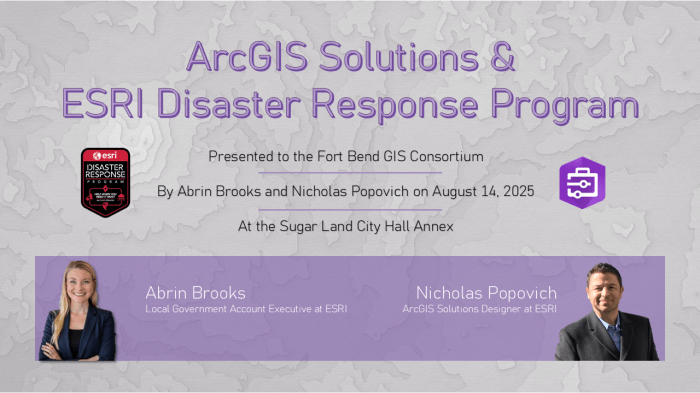
Sugar Land City Hall Annex, August 14, 2025 – Mrs. Abrin Brooks and Mr. Nicholas Popovich presented as representatives of ESRI on the ArcGIS Solutions platform and the ESRI Disaster Response Program to members of the Fort Bend GIS Consortium (FBGISC). ArcGIS Solutions are a collection of free, industry-specific configurations of ArcGIS that can be deployed by an organization to improve operations and enhance services. These solutions use an organization’s authoritative data and can be used as is or customized to fit unique needs. They range in scope from a single ArcGIS Pro project to a series of integrated ArcGIS applications and are included with ArcGIS, deployable in an ArcGIS Online organization or an ArcGIS Enterprise portal.
To set the tone for this workshop, Mrs. Brooks communicated that ArcGIS Solutions is included with all members base small local government service contracts with ESRI. This clarified that the technology showcased during the workshop was for currently accessible and not a sales demonstration for members.
ArcGIS Solutions are designed as ready-to-go templates with customization features, similar to ArcGIS Instant Apps. Searchable templates from both official and user sources are available to serve as both an immediate solution and design ideas for your organizational needs. Mrs. Brooks and Ms. Anna Gonzalez provide support to our local public entities while Mr. Popovich works on development directly related to ArcGIS Solutions.
Mr. Popovich provided a live-walkthrough demonstration of the ‘GIS Request Management’ solution he developed for ESRI. This solution serves as a ticketing system, technology use, and departmental activity metrics. In addition to operational benefits, the solution adds a layer of transparency to your GIS department’s operations by documenting and archiving past, ongoing, and planned activities. It was also noted that nearly all FBGISC member organizations are actively using this solution to some degree already. Given the solutions integration-friendly design with other ticketing platforms from major vendors, this solution offers a seamless option to better service clients and track projects, serving as a ready-made framework for advanced solutions beyond the out-of-box offerings.
In addition to the official ESRI solutions, ESRI has also provided video-introductions and help-documentation for their templates and include create all ESRI templates so that they are compatible with base contracts, without additional costs attached.
In summary, Mr. Popovich highlighted the ‘GIS Request Management’ solution as a tool for submitting and tracking work requests, that additionally provides metrics and logs for internal monitoring. The solution offers levels of access, such as team / manager / program to ensure the right people have the right access, keeping the solution focused on desired intents, whether those are tracking progress, reaching department goals, or monitoring program time & effort metrics. Lastly, community data sharing with Apple Maps and TomTom improve location based access and ticket tracking. ESRI is working on expanding this location collaboration to Google Maps as well.
Following the ArcGIS Solutions workshop, Mrs. Brooks gave a brief overview of ESRI’s Disaster Response Program (DRP). The Esri Disaster Response Program (DRP) is a corporate citizenship initiative that provides GIS support to organizations worldwide during crises. The program, which has been active for over 25 years, offers 24/7 assistance, including software, data, configurable applications, and technical support. Its goal is to help organizations improve situational awareness, make better decisions, and respond more effectively to a wide range of disasters, such as earthquakes, floods, and wildfires, as well as public health crises. The DRP has provided assistance during notable events like the COVID-19 pandemic and Hurricane Katrina.
This program was notably used by the City of Sugar Land in response to Hurricane Beryl, allowing the City’s first-responders and Office of Emergency Management to respond with a complete geospatial toolkit at the ready, without the need to purchase of additional licenses and backed up with additional support directly from ESRI.

 FBGISC